
What Is a Guru? The Ten Facets of Guruism
This article serves as a glossary or reference for all the useful concepts put forward by Matthew Browne and Chris Kavanagh on their podcast "Decoding The Gurus".

“Decoding The Gurus” (DTG) is a podcast by psychologist Matthew Browne and anthropologist Chris Kavanagh.
Here is a picture of them:

The object of analysis for Browne and Kavanagh is the “secular guru”. They employ many useful terms and concepts to discuss this and how “guruism” presents itself in today’s media landscape.
I am first going to explain what a secular guru is according to Browne and Kavanagh, and then use their “gurometer” test to explain many of their other interesting concepts associated with “guruism”.
Secular Gurus:
"The most concise definition of a guru is “someone who spouts pseudo-profound bullshit”, with bullshit being speech that is persuasive without any regard for the truth. Thus, all these properties relate to people who produce ersatz wisdom: a corrupt epistemic that creates the appearance of useful knowledge, but has none of the substance." - DTG
A secular guru is a modern, non-spiritual guru figure who presents themselves as an authority on a wide array of topics, often outside their formal expertise.
Such individuals brand themselves as uniquely qualified to offer special insight or a bespoke worldview that followers supposedly can’t get from traditional experts or media.
They usually maintain a veneer of scholarship or science (e.g. academic credentials, calm rational tone) while espousing personal theories or life advice.
Unlike classic religious gurus or loud fringe pundits, these secular gurus often operate via podcasts, YouTube, and social media, cultivating a loyal audience around their personality and ideas.
Examples include figures like Jordan Peterson, Russell Brand, or the Weinstein brothers.
Guruism then, is the phenomenon of secular gurus and describes charismatic figures promoting their own narrative or ideology (often in opposition to mainstream views) and leveraging their audience’s trust for influence or profit.
The Gurometer - Ten Facets of Guruism:
The gurometer is a means of rating how much a given figure exhibits the qualities of guruism… Browne and Kavanagh use this system to rate and rank gurus based on how guruey they are…. or how much gurosity they display…
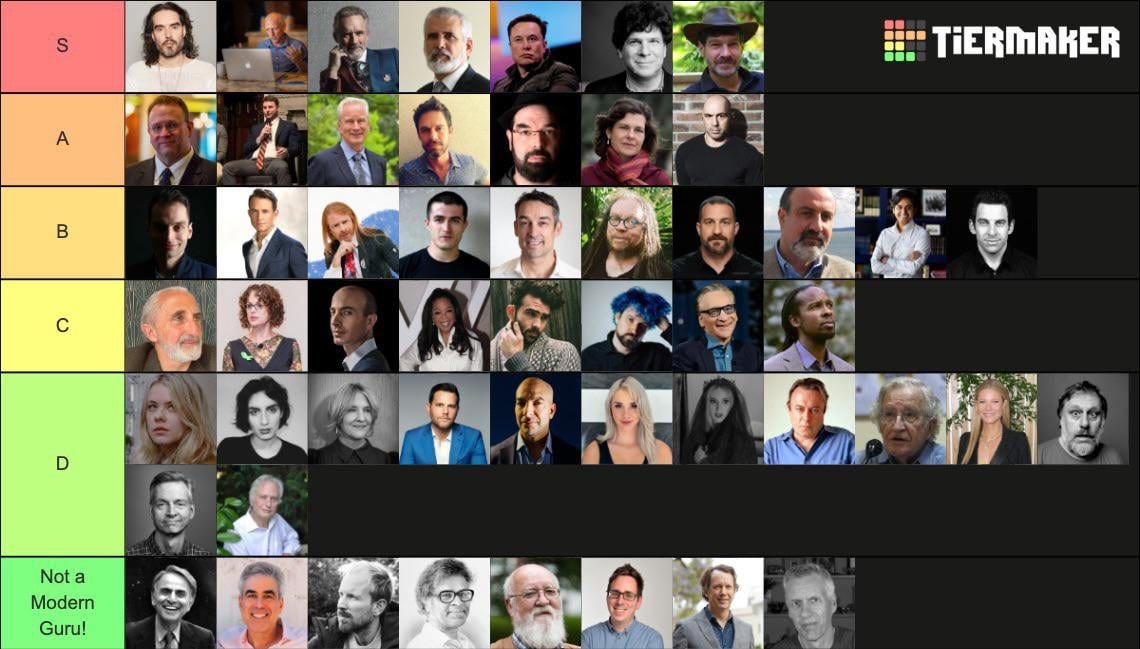
(The DTG official guru tier list, based on the findings of the gurometer.)
The gurometer has 10 facets which I will now explain:
1. Galaxy-Brainness:
“Galaxy-Brainness” describes the willingness to talk confidently about many different disciplines, speculatively linking a vast array of topics with no regard for genuine expertise.

Gurus have the tendency to opine on anything and everything with supreme confidence, projecting an aura of far-reaching intellect.
Galaxy-Brainness is the willingness to venture bold hot takes across a constellation of topics well beyond one’s expertise.
A galaxy-brained guru presents elaborate, grandiose theories about science, politics, culture, often connecting disparate ideas in a way that sounds profound but may be superficial or ill-informed.
This trait conveys the guru’s self-image as a limitless thinker, since they act as if their intellect spans the entire universe of discourse.
For example, Jordan Peterson refers to himself as a clinical-psychologist, yet is very comfortable outside of his domain of expertise. Peterson routinely comments on climate change, COVID vaccines, public policy, geopolitical conflicts like Russia’s invasion of Ukraine, and other subjects without any regard for expert opinion.
Gurus and their followers might respond to accusations of galaxy-brainness by stating their approach is actually “inter-disciplinary” and that no single field of study alone can solve today’s issues. They also might appeal to conspiracy theories or discount “establishmentarian” ideas like peer-review. This facet of guruism will be addressed later in the article.
2. Cultishness:

Cultishness refers to the intense fandom that often surrounds a guru, and how the guru employs social control techniques often associated with cults.
Cultishness is evident when a guru fosters a devoted, insular community. An in-group of followers that share insider jargon, defend the guru vehemently and dismiss critics as belonging to the out-group.
The guru often laments the lack of robust criticism against their position. Their followers believe opposing views are badly motivated or the result of a conspiracy, strengthening the in-group / out-group distinction.
The best example of cultishness is to just click on any video on a guru’s YouTube channel and see the sheer reverence their followers have for them. The level of glazing is seriously unmatched.
Cultishness is particularly insidious because the guru is no longer just selling ideas, but positioning themselves as the leader of a tribe of believers.
Through out this article, the use of manipulation techniques to strengthen tribal loyalties will be a recurring theme.
3. Anti-Establishmentarianism:
This one contains two highly related sub-facets as well; scientific hipsterism and extreme reflexive contrarianism.

Anti-establishmentarianism describes a disparaging attitude towards institutional knowledge, as well as mainstream academics or journalists.
This attitude tends to view mainstream knowledge as limited and unable to confront the real issues of our times.
Within this anti-establishment stance, Kavanagh and Browne identify a pattern dubbed “science hipsterism.”
This is the tendency for gurus to latch onto obscure or contrarian scientific ideas before they’re cool, as a way of seeming ahead of conventional experts
For example, a guru might accept that climate change is real but insist it’s caused by an esoteric factor (like mysterious Siberian craters) rather than the well-established explanation.
By championing niche theories or fringe data, the guru positions themselves as a visionary who sees what credentialed scientists and the “herd” have missed.
This science hipster flair and anti-establishment posturing go hand-in-hand – together, they reinforce the guru’s narrative that they are the enlightened rebel in a world of sheeple.
Another term to help us understand this is “extreme reflexive contrarianism”.
It refers to the automatic, unthinking opposition to mainstream ideas or institutions, not because the alternative view has been carefully reasoned or supported by evidence, but because it is mainstream.
If you are allergic to words like peer-review, CDC, journalist, expert-consensus, then you might be guilty of extreme reflexive contrarianism…
Often the “well acktually”s and “both sides are bad”s of contrarian opinion automatically sound smarter than a well-supported, mainstream position, simply because it is going against the grain.
That air of defiance can give even lazy or shallow arguments a false aura of depth.
Consider “The Intellectual Dark Web (IDW)”, a term coined by Eric Weinstein for a loose group of “public intellectuals” and media personalities who style themselves as heterodox thinkers pushing back against “cancel culture” and progressive orthodoxy.

This goes to show that gurus and their followers, rather than being the consumers of a vast media empire’s online content, see themselves as an underground, dark web of rebellious, intellectual geniuses.
The IDW as a concept was introduced in a 2018 New York Times article, one of the most historic and largest newspapers in the world, a fact that is also surprising on their self-image.
4. Grievance Mongering:
Gurus are constantly airing grievances and portraying themselves (or their in-group) as the victims of injustice or suppression.
They routinely claim they’ve been silenced, persecuted, or “canceled” by academia, the media, or society at large. At the heart of guruism is a narrative of persecution.
It is true that gurus promote views that aren’t taken very seriously by experts in their relevant fields. Grievance mongering provides a narrative to their audience as to why the guru (and their followers) haven’t been recognized or valued by society and its institutions.
Eric Weinstein’s promotion of his largely rejected physics theory, Geometric Unity, is a textbook case of grievance-mongering.

Rather than submitting the theory for peer review, Weinstein claims the academic community is too closed-minded or corrupt to engage with his ideas.
In a nutshell, the guru reverts to conspiratorial ideation to explain why their ideas haven’t been accepted and speaks of those who hold opposing views as “their enemies”.
This is of course more appealing than the alternative explanation, that the guru’s theories aren’t taken seriously by mainstream institutions because they are bad theories…
The irony of grievance mongering is the difficulty in explaining how the guru is both oppressed and silenced while often having become multi-millionaires from their large platforms and dedicated audiences.
This irony is made even more apparent by the next facet on the gurometer…
5. Self-Aggrandizing and Narcissism:
In addition to explaining how guru’s exhibit narcissistic tendencies, I am also going to explain the concepts of “yes, and…” conversations and “civility porn”.
Firstly, gurus exhibit inflated ideas about their own self-importance and regularly report their level of influence, contacts, and audience size.
Self-aggrandizement might include boasting about intellectual superiority, name-dropping associations with big names, or endlessly plugging their books and projects as world-changing.
The guru sees themselves as more than a mere podcaster or social media figure. They see themselves as the aforementioned underground geniuses saving civilisation.
Kavanagh and Browne have summed up this tendency as ”saving the west through podcasting", as the guru’s audience usually confuses podcasting with some kind of academic or scholarly pursuit.
(Bret Weinstein saying he has figured out “the meaning of life, the world and everything”.)
Like a vulnerable narcissist, gurus are highly sensitive to criticism. They very rarely seek opposing voices and tend to have “yes, and…” conversations with guests.
In a “yes, and…” conversation, each speaker delivers a long, abstract monologue, which the other politely affirms before launching into their own. There is no real dialogue, just a mutual exchange of uninterrupted self-expression.
This format flatters the guru’s ego: they get to sound profound without facing scrutiny. The absence of disagreement helps preserve their image as insightful and authoritative, which is especially important for someone who is deeply invested in being perceived as brilliant.
The conversation becomes a stage for performance, not a space for growth or correction. The goal is just to appear smart by putting cool strings of sentences together.
This is where the concept of “civility porn” comes in. A key feature of the “yes, and…” conversation is the lack of push-back. Civility porn takes this further by elevating the lack of push-back into a virtue.
You will notice the comment section under a guru’s conversation is full of praise for the civility and listening skills exhibited by either party.




(Some YouTube comments under Lex Friedman’s most recent interview with Jordan Peterson.)
When gurus converse with each other, there is little to no disagreement, and yet the discussion is celebrated by followers as thoughtful, elevated, and intellectually honest.
Rather than risk the narcissistic injury of being wrong or exposed, the guru curates interactions where everyone agrees, disagreement is avoided, and politeness is mistaken for rigor.
The result is their followers fetishizing their calm and polite echochamber, reinforcing the idea that disagreement is rude or unproductive and instead seeking out shallow, agreeable conversations.
Worse yet, the guru’s followers also confuse this as “academic”. In reality, academic work is defined by constant criticism, debate, and uncomfortable questioning. Scholars regularly have their ideas challenged, refined, or rejected.
Just ask any PhD student what it’s like to wake up each day to the dreaded red pen… Relentless feedback is the norm, not agreement.
One of the ironies of civility porn, is how uptight and combative gurus tend to get when they are confronted with criticism. Watch the civility go right out the window.

Gurus rely on dynamics like “yes, and…” conversations and civility porn as a means of crafting safe spaces where their authority is never seriously questioned. That tells us a lot about their need for validation and low tolerance for criticism, both hallmarks of narcissistic behavior.
Another narcissistic trait is that they tend to believe they hold "revolutionary theories" despite having limited academic output and publishing zero to few papers. This point has it’s own place on the gurometer and will be expanded upon later.
6. Cassandra Complex:
In Greek Mythology, the Trojan princess Cassandra was given the gift of prophecy but cursed so that no one would believe her.
Likewise, the term “Cassandra complex” refers to the guru’s habit of making dire predictions of looming disaster, such as the collapse of western civilization, and that society is involved in a coordinated effort to ignore the oncoming dangers.
Some of these impending dangers might include postmodern neo-marxism and the woke mob, the great reset or a medical catastrophe as a result of the COVID vaccines.
In the case of Jordan Peterson, he has literally refereed to himself as “Cassandra” in an allusion to the myth, seemingly unaware of its disparaging use elsewhere.
The key element is that the guru casts themselves as a prophetic voice crying out in vain; they are “warning of terrible dangers” but are not believed by the complacent masses or corrupt elites.
The guru will dwell on instances where they made “correct” predictions, typically employing the sharpshooter fallacy and ignoring their predictions that failed.
The guru’s Cassandra complex provides an emotional hook and uses fear to strengthen in-group loyalty. It also heightens the guru’s perceived importance.
7. Revolutionary Theories:
As touched on under “self-aggrandizement and narcissism”, gurus have a tendency to see their own views as paradigm-shifting.
This facet overlaps with galaxy-brainness and the guru’s penchant for proposing grand “Theory of Everything” ideas or radical new frameworks that purportedly revolutionize their field (or multiple fields at once).
These theories are often presented with great fanfare by the guru, who compares themselves to scientific visionaries of the past like Copernicus or Einstein.
Kavanagh and Browne state that many gurus explicitly or implicitly invoke the “Galileo Gambit”: a complex in which someone likens themselves to a lone genius mocked by the establishment, only to eventually be proven right (“They laughed at Galileo, and they’re laughing at me, too”).
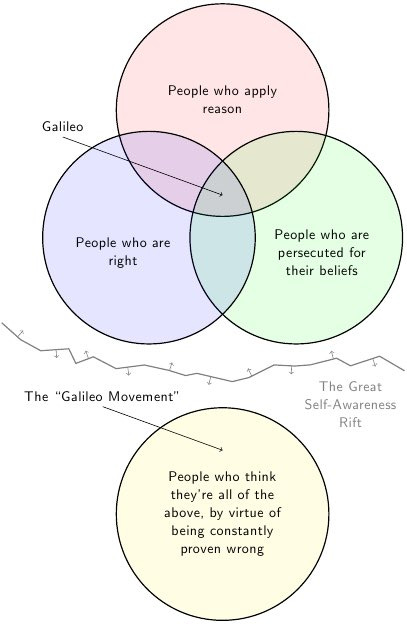
Many gurus liken themselves to Galileo, Einstein or other figures in history that were initially thought to be wrong to preemptively dismiss criticism. They also appeal to conspiratorial forces to explain why their views aren’t accepted by relevant experts.
Revolutionary theories include things like Eric Weinstein’s highly speculative Geometric Unity theory in physics, or Bret Weinstein’s unorthodox ideas about COVID-19 and evolution.
However, for every genuine Galileo, there are countless people claiming to be Galileo who are just wrong.
The allure of revolutionary theories is in giving followers the sense that they possess secret knowledge. This plays into the narcissistic desire to feel smarter and more awake than the masses, who in turn are seen as blindly accepting mainstream narratives without question.
8. Pseudo-Profound Bullshit:
Obligatory Harry Frankfurt quote:
“It is impossible for someone to lie unless he thinks he knows the truth. Producing bullshit requires no such conviction.”
In January 2017, White House Counselor Kellyanne Conway defended Press Secretary Sean Spicer’s inaccurate statements about the size of President Trump’s inauguration crowd by referring to them as “alternative facts.” This phrase was widely criticized as an attempt to present falsehoods as legitimate perspectives, exemplifying speech that disregards the truth.
Furthermore, “bullshit” is a technical term in philosophy coined by Harry Frankfurt in his essay “On Bullshit”. The term refers to statements that are constructed absent direct concern for the truth. This is distinct from lying, in which the liar wants to conceal, manipulate or obfuscate the truth. The bullshitter shows no concern for the truth whatsoever.
People bullshit to appear informed, to cultivate personal brands, increase tribal loyalty, to win campaigns, to reinforce systems of power and a plethora of reasons in which concern for the truth is performative at best.
“Pseudo-profound bullshit” refers to language which appears to be profound and insightful, but actually is trite, tautological or vacuous.
In other words, pseudo-profound bullshit is a kind of bullshit where the bullshitter willingly trades away the truth for the sake of sounding profound.
“A whale is a giant carcass. So when something dies, you could say its spirit is embedded in that carcass, that’s a good way of thinking about it. When things deteriorate, you end up with these carcasses lying around with their dead spirits. The spirit of what gave rise to them is still inside, and the task is to go into the carcass and revitalize the spirit that produced it, not to parasitize it.” - Jordan Peterson on Pinocchio
The guru speaks pseudo-profound bullshit through liberally using obscure references, technical jargon or philosophical language, especially where plain English would suffice.
This often involves connecting multiple metaphorical concepts at once while making a shallow point. The reason one would use language so performatively like this is not to better make a point, but to impress the uninformed and naive viewer.
Gurus will evade clarity at all costs. The ultimate red flag of pseudo-profound bullshit is when the guru resists any attempt to rephrase their views in plain English.
9. Conspiracy Mongering:
This refers to the tendency to indulge in conspiracy theories or weave conspiratorial narratives around events. These can range from grand narratives about elites working to undermine Western society, to smaller scale claims, like the idea that the guru is being silenced by academia.
In either case, the guru has a special knack for promoting conspiracies that are self-serving. These conspiracies serve as a “get out of jail free” card in which the conspiracy achieves the following:
Explains why any opposing worldview exists – Alternative views are not just wrong, they’re part of a coordinated attempt to deceive or mislead.
Justifies why their ideas are rejected by experts – The lack of institutional acceptance is reframed as proof of suppression, not weakness.
Increases follower loyalty and heightens tribalism – Belief in a shared enemy strengthens in-group bonds and encourages distrust of outsiders.
Turns criticism into validation – Attacks from the media, academia, or other gurus are seen as confirmation that the guru is over the target.
Positions the guru as a heroic truth-teller – They’re not just offering ideas, they’re risking everything to fight a corrupt system.
Creates a moral urgency to act – The stakes are high, and only the guru and their followers are awake to the danger.
Profit ??? - Opens up monetization opportunities as followers will buy sponsored products and subscription services not just to support the guru but in to fight the conspiracy.
Do you like lists? I like lists…
Conspiracy-mongering is one of the most important facets of guruism. It is difficult to separate this one from the other points on the gurometer.
Through conspiracy mongering, the guru justifies their outsider status and reinforces followers distrust of all other sources of information.
10. Profiteering:
This facet assesses to what extent the guru is financially exploiting their followers or platform.
Many of the gurus are not living on the modest salaries of most academics, but own multi-million dollar social media empires.
Obviously, there is nothing wrong with making money… even a lot of money… However, the degree to which gurus monetize their audience is extremely aggressive and shameless.
Many gurus don’t just restrict themselves to subscription or monetizing services like Patreon, but sell books, paid courses, merchandise and supplement lines.

The irony is that such a level of profiteering would seem to be at odds with the guru’s narrative of being a heroic freedom fighter only concerned with the truth and saving western civilization.
Would you expect an expert in physics or a genius philosopher to be selling a line of supplements?
Additionally, profiteering gurus are often eager to collaborate with and promote one another, even when they share little in common, aside from a tendency to push conspiracies.
That’s All Folks:
Matthew Browne and Chris Kavanagh of the Decoding The Gurus Podcast have offered an excellent conceptual utility belt to understand the current media landscape, which is seemingly dominated by gurosity.
The fact is, gurus hold large amounts of influence in society and yet, have convinced their followers that they are disempowered.
This combination is dangerous, as it justifies handing over even more power and resources to those who use their enfranchisement to spread misinformation about life-saving vaccines and victims of unjust invasions.
Oh yeah, here is a link to their YouTube channel:
https://www.youtube.com/@decodingthegurus
Signed, TDT
Writing from the sweet, sweet state of Georgia in the Caucuses, just like Stalin was.
What an unbelievable accurate description of the culture of today - you've managed to put into words what I've been observing and questioning for the past 2 years, adrift in the webs of the internet.
One thing that stood out, this, is the now viral question of what expertise is. To me, the fake guru is the one that unnecessarily over embellishes their speech and speaks in absolutes - unless you're conveying an opinion, to which everyone is entitled to have, absolutes demands that you've done your research and have the proof to back it up. To me, this is when the red flag goes up and the bells ring.
If we're all to study deeply the few concepts that truly boggle our minds, then I'm sure wel end up having lots of different perspectives and emotional reactions, who eventually will lead to an open and humble debate. No adoration of idols, no idolatry of YouTubers, just plain information exchange. Thank you for this piece!! 👌🏻
I find the discussion around guruism a little ironic. Don‘t get me wrong, this is a well-written article which conveys the point it wants to make succinctly, but I struggle to see the level of „useful knowledge“ I am getting from classifying gurus.
For instance, despite the ten criteria, their tier list may as well be entirely random. From those of the people on the list that I have heard of, I would have no clear idea why they ended up in their particular position. Despite me disliking some of the figures in the upper tiers for their phoniness or whatever, I am not sure if that means they are more like a guru than those below them. It seems to me like a categorization that is very hard to separate from personal agreement/disagreement with their positions.
I could give examples, but they would obviously be biased according to my personal sense of getting a „guru vibe“ from people.